Robo Defense
- 3.7
- Rating
- 500.00K
- Installs
- $2.99
- Price

 Analysis by App-foxy
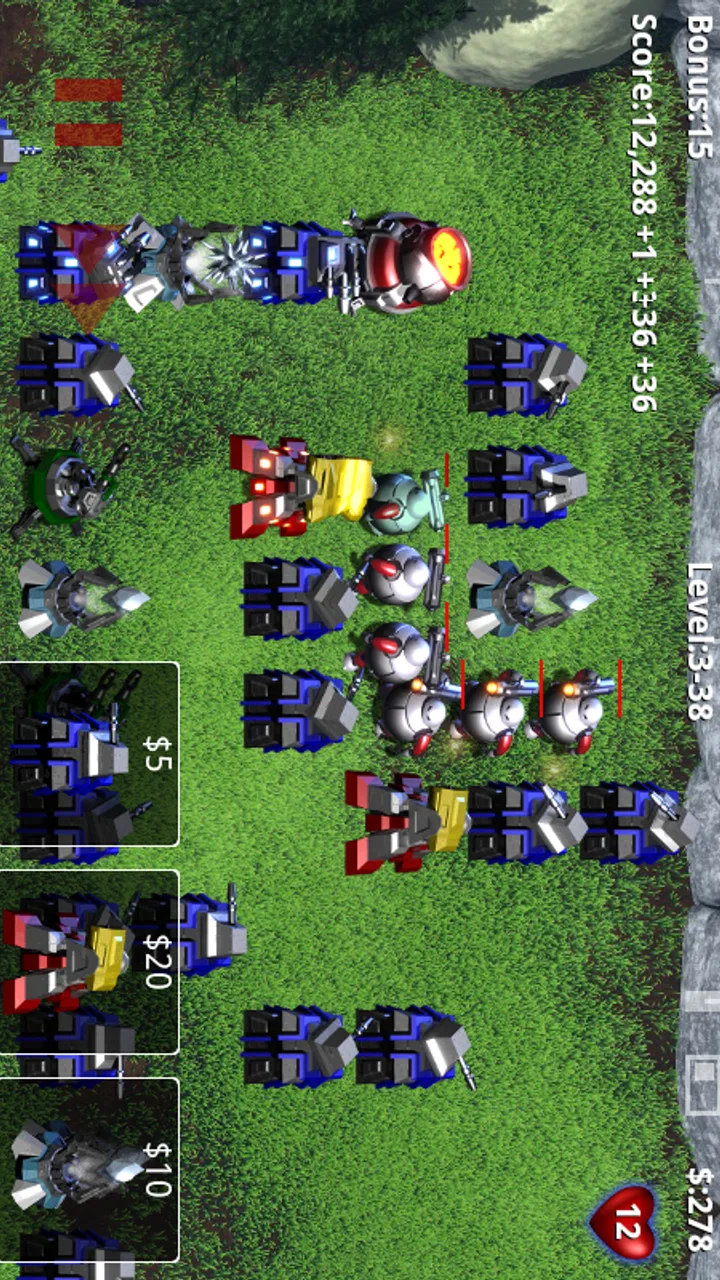
I first approached Robo Defense as a quick arcade game rather than something I would keep installed for months. That turned out to be a useful way to judge it. Its appeal is immediate: place defensive units, watch enemies move through the route, react when a lane becomes dangerous, and try to hold the line a little longer than before. The basic idea is easy to understand, but the decisions become more interesting once a careless placement leaves you short of firepower at the wrong moment.
Developed by Lupis Labs Software, this is a paid Android tower-defense game in the arcade category. It costs $2.99, carries an Everyone 10+ age rating, and has passed the half-million-install mark. Those details put it in an unusual position. It is not competing only with other premium games; it also has to justify itself beside the many free tower-defense alternatives that ask for patience, advertising, or repeated spending. In my experience, its strongest argument is not spectacle. It is the simple pleasure of having a focused strategy game ready whenever I want a short tactical distraction.
Why the first week feels better than the store summary suggests
The first sessions work because the game does not require a long explanation before the central loop makes sense. I can look at the route, identify the places where enemies will spend the most time, and decide whether to strengthen an existing position or cover a weak approach. That clarity matters on a phone. A complicated interface can make a small screen feel like a control panel, while Robo Defense keeps the attention on the immediate defensive problem.
You May Also Like

 Blood Strike: 2.5 Anniversary
Blood Strike’s Loadouts Turn Every Drop Into a Tactical Gamble
A close look at Blood Strike’s custom loadouts: how fast access to signature weapons reshapes its battle royale rhythm, rewards preparation, and narrows the gap between fights.

 Pandora - Music & Podcasts
Pandora’s Music Is Easy to Start, but Harder to Recover
Pandora’s strength is its low-effort path from a seed to a station. Its weak spot is how much confidence it asks you to place in connection, setup, and quiet recovery.

 8 Ball Pool
 Is Built on Rivalries, Rematches, and Routine
A close look at the rivalries, rematches, shared routines, and unanswered safety questions that turn a quick pool match into a persistent mobile community.

 Samsung Music
’s Quiet Strength Is Playing What You Already Own
Its reach comes less from spectacle than from dependable access to a personal library. That simplicity is both the app’s strongest retention engine and its ceiling.

 AccuWeather: Weather Radar
AccuWeather Review: A Quick, Clear Forecast for Everyday Decisions
For everyday plans, the best forecast is the one you can understand quickly. AccuWeather makes rain timing, radar, and local conditions easy to act on, with a few trade-offs.

 Hill Climb Racing
Why Hill Climb Racing Still Turns Crashes Into One More Run
A tiny car, a bumpy hill and one more upgrade: Hill Climb Racing keeps resurfacing because its simple chaos makes every near-miss feel personal.
More From Our News Desk
View All News


What I enjoy most during the opening stretch is the way a successful setup can still become unstable. A position that looks safe at the beginning may stop being enough when the pressure changes. That encourages me to observe rather than simply repeat the same placement pattern. The best early habit is to treat every round as information: notice which path is becoming costly, which defensive choice is doing useful work, and which purchase only feels powerful because it is new.
The game is particularly suitable for short breaks. I can play while waiting for an appointment or during a quiet part of a commute, then put it down without needing to remember a large story or a complicated quest chain. That convenience is a genuine strength, although it also reveals one of the game’s limitations: if I am looking for a large adventure, character development, or a constantly changing world, this is deliberately not that kind of experience.
During the first week, I recommend resisting the urge to spend every available resource as soon as it appears. A defensive network usually benefits more from covering a dangerous gap than from making one already-effective position slightly stronger. That sounds obvious, but the game’s visual feedback can tempt me into upgrading the unit that is currently producing the most satisfying results. The more useful question is whether the whole route is secure, not whether one location looks impressive.
Another practical tip is to watch the route before making a decision. The shortest-looking path is not always the most important one. A location where enemies remain exposed for longer can be more valuable than a position near the entrance, even if the entrance feels urgent. I found that this small change in attention made my decisions less reactive. Instead of chasing whatever was closest to failure, I started planning around the places where defensive strength could affect several moments of a wave.
The paid model also changes the first-week experience. Paying once is easier to understand than entering a free game and discovering that progress is shaped by repeated interruptions or purchases. That does not automatically make every design choice ideal, but it does make the relationship with the game feel more straightforward. I can judge the gameplay on its own terms instead of wondering whether a difficult moment is asking me to spend more money.
Still, the opening appeal depends heavily on whether a player already likes tower defense. Someone who wants rapid reflex action may find the pace too deliberate, while someone who prefers a puzzle game with a fixed answer may dislike the pressure of adapting as the defense develops. I would recommend it to a friend who enjoys thinking ahead in small spaces, but I would not present it as a universal arcade game.
The small decisions that make a run feel personal
One of the less obvious pleasures is that a run can reveal my own style. I tend to build a dependable central defense and then patch the edges, which feels safe but can leave me underprepared when the pressure shifts. A more aggressive player may spread resources across several positions and accept more risk. The game gives those choices room to matter without turning the experience into a long management exercise.
I also learned to separate a temporary emergency from a permanent weakness. If one section looks dangerous for only a short time, a modest response may be wiser than rebuilding the entire defense around it. By contrast, a route that repeatedly causes trouble deserves a structural solution. This distinction is useful because it prevents a common tower-defense mistake: spending heavily to solve the last problem I saw, then discovering that the next problem is somewhere else.
That kind of observation is where the game offers more depth than its compact presentation implies. It does not need a large cast or a dramatic campaign to create decisions. The route, timing, and limited attention are enough to make each attempt feel like a test of priorities. The trade-off is that the experience remains tightly focused. Players who need a strong sense of discovery may feel that they have seen the main idea before the first week is over.
What remains useful after the novelty fades
The more important question for a paid mobile game is not whether it entertains me on the first evening. It is whether I still have a reason to return after the initial learning period. Robo Defense does reasonably well here because its core activity is easy to resume. I do not need to reconstruct a complicated plot, remember a collection of characters, or wait for a new event. I can open it, make a few tactical decisions, and leave again.
That makes it a good companion for a recurring habit. I can use it as a short mental reset after work, especially when I want something more engaging than passive scrolling but less demanding than a full console-style session. The game asks me to concentrate for a while, yet the subject matter is simple enough that I am not carrying a story or a long-term social obligation into the rest of my day.
Its month-to-month value depends on how much I enjoy refinement. The strongest reason to keep playing is not a constant stream of novelty; it is the satisfaction of making fewer wasteful decisions. I can return to a familiar challenge and approach it with better timing, more disciplined spending, and a clearer idea of which defensive positions deserve priority. That is a durable form of replay value, but it will not satisfy players who measure longevity mainly by new content.
Compared with free tower-defense games, the advantage is the cleaner commitment. A free alternative may offer more visible rewards, more frequent prompts, or a broader progression structure, but it may also ask for more of my attention outside the actual strategy. Robo Defense feels better suited to someone who wants the game itself to be the main activity. The disadvantage is equally clear: a free competitor can be easier to try casually, and some players may prefer a larger presentation even if it comes with more interruptions.
Compared with premium strategy games, this one is lighter and more immediate. I do not choose it when I want a deep campaign or a large system of interconnected decisions. I choose it when I want the recognizable tower-defense problem without committing to a long session. That distinction helps set expectations. It is not a replacement for every strategy game; it is a compact option for the moments when a focused defensive puzzle is exactly what I want.
For regular use, I find that alternating between active sessions and short breaks works better than forcing myself to play every day. Because the central loop is familiar, overplaying can make the decisions feel routine. Returning after some time lets me notice the structure again instead of treating each round as a checklist. In other words, the game benefits from a healthy rhythm rather than constant attention.
Who gets lasting value from it
I think the best audience is someone who enjoys planning under pressure but wants a game that respects short sessions. It also suits players who prefer a direct purchase to a free-to-play routine. The age rating of Everyone 10+ makes it approachable for a broad audience, although younger players may still need help understanding why saving resources can be more valuable than immediately improving the strongest-looking position.
I would be more cautious recommending it to someone who needs a strong social layer, a story, or a steady supply of surprises. I would also steer away from it for a player who dislikes repeating a challenge to improve a result. The game’s recurring value comes from learning and adjustment. If that process feels like repetition rather than mastery, the $2.99 price may be harder to justify.
A realistic everyday use case is a ten-minute pause between tasks. I can begin a session with one simple goal, such as checking whether my defense is too concentrated in one area, and stop once I have tested that idea. This is more satisfying than opening a game with a large daily checklist because the session has a clear mental shape. I am making decisions, not merely collecting items before closing the app.
That said, the same compactness can become a weakness. If I am tired and want something almost automatic, the game still expects me to pay attention. If I am in a hurry, an unsuccessful run can feel unfinished rather than relaxing. It is a good short-session game, but not every short session is the right moment for strategy.
Maintenance, friction, and the reasons fatigue can appear
One benefit of the design is that it does not demand much maintenance from the player’s life. There is no need for me to organize a team, follow a social schedule, or keep up with a complicated collection. I can leave it alone and return later without feeling that I have fallen behind. For a mobile game, that low obligation is valuable, especially for people who want entertainment rather than another routine to manage.
The maintenance burden is instead placed inside each session. I have to monitor the route, notice when a defense is no longer efficient, and make decisions before a small weakness becomes a large one. That is manageable, but it means the game is not truly effortless. The player maintains the defense moment by moment, and the satisfaction comes from doing that well.
My main source of fatigue is repetition without a fresh personal objective. When I play only to finish another round, familiar decisions can lose their edge. I get more from the game when I set a specific experiment: try a more balanced layout, delay an upgrade, or protect a previously neglected section. These self-imposed goals keep the system interesting without pretending that every session will feel new.
Another source of friction is the possibility of overvaluing visible progress. A stronger-looking unit or a successful early section can create false confidence. If I spend according to what feels rewarding instead of what the route actually needs, later pressure exposes the mistake. This is not a flaw unique to tower defense, but Robo Defense makes it central because the game’s enjoyment depends on reading the field accurately.
The average rating of 3.7 from around 66 thousand ratings, alongside roughly 10 thousand written reviews, suggests that the game has a substantial audience but is not universally loved. I read that as a useful warning against treating its simplicity as a guarantee of quality for everyone. The same focused approach that makes it convenient can also make it feel limited. A player should choose it for the core loop, not for features that belong to a larger genre production.
Its audience size, with over 500 thousand installs, also tells me that this is not an obscure experiment that only works for a tiny niche. Even so, popularity does not solve the question of personal fit. I would spend the money if I already knew I liked compact tower defense and wanted a paid version for quick sessions. I would hesitate if I were still deciding whether the genre itself holds my attention.
When another game would be the better choice
I would choose a free alternative when I want to sample the genre without paying first, or when I specifically want a more elaborate progression structure. I would choose a larger premium strategy game when I want a campaign, richer presentation, or decisions that extend beyond defending a route. I would choose a faster arcade title when my priority is immediate reaction rather than careful placement and resource timing.
Robo Defense is the better choice when I want the opposite: a contained game, a clear objective, and enough tactical pressure to make a short break feel active. The paid price is easier to defend for that use case because the game does not need to become a second hobby to be worthwhile. It only needs to provide a reliable, enjoyable session whenever I return.
For anyone concerned about whether it is suitable for occasional play, my answer is yes, provided you are comfortable relearning the flow of a defense after time away. The game’s basic idea is easy to recover, and the low-maintenance structure helps. For someone asking whether it can replace a deeper strategy game, my answer is no. Its value is in focus, not breadth.
My long-term verdict on keeping it installed
After the first-week novelty fades, Robo Defense earns its place through convenience and repeatable tactical decisions rather than a constant parade of new material. I like that I can pick it up without preparing for a long session, and I appreciate that the central challenge rewards attention instead of spending or social participation. The best moments come when I recognize a weakness early and solve it with a measured change rather than a frantic reaction.
It is not perfect. The focused format can become tiring if I play too many similar sessions without a personal goal, and players looking for story, spectacle, or broad progression will probably outgrow it quickly. The paid price also makes genre familiarity important: I would not recommend buying it blindly to someone who has never enjoyed tower defense.
For me, though, it remains a credible long-term mobile game because it fits into real life. I can play it during a short pause, leave it alone for a while, and return without maintenance chores. That is a stronger form of recurring value than a temporary novelty. If you enjoy compact strategy and want a dependable offline-style arcade habit rather than an endlessly expanding service game, Robo Defense is worth considering.
My recommendation is therefore positive but specific. Buy it for the clean defensive loop, the ability to improve through observation, and the freedom to play in small pieces. Skip it if you need constant content, a narrative reason to return, or rapid action with little planning. In the right hands, it is a modest but lasting game: not the biggest tower-defense experience on a phone, but one that can remain useful because it asks for attention without demanding your entire schedule.
FAQs for Robo Defense
01What is Robo Defense?
Robo Defense is a classic tower defense game for Android in which you protect your base from waves of advancing robots. You place defensive towers, upgrade their abilities, and choose suitable strategies for different enemy types and maps. Its straightforward controls make it easy to start, while increasing difficulty and multiple upgrade options provide enough challenge for players who enjoy tactical planning.
02How does the gameplay work in Robo Defense?
The main objective is to stop enemies before they reach the end of the route. You earn resources by defeating attackers and spend them on building or improving defensive units. Each tower has different strengths, ranges, and attack characteristics, so success depends on positioning and timing rather than simply placing the most expensive option. Later waves require careful adaptation to enemy speed and durability.
03Can Robo Defense be played offline?
Yes, Robo Defense is generally designed as an offline-friendly game, allowing you to play its main tower defense levels without requiring a constant internet connection. This makes it suitable for commuting, traveling, or short gaming sessions where mobile data is unavailable. However, store functions, updates, or any platform-specific features may still require internet access depending on your device and installed version.
04Is Robo Defense free to download and does it include in-app purchases?
Robo Defense has traditionally been available as a free download, although the exact edition, advertising model, and available content can vary between stores or versions. Some releases may offer optional purchases or a separate paid edition with additional features. Before installing, check the current Google Play or App Store listing for pricing, advertisements, permissions, and whether extra maps or upgrades are locked behind payment.
05Is Robo Defense suitable for beginners and children?
Robo Defense is relatively easy for beginners to understand because its core mechanics are simple: build towers, stop enemies, and upgrade your defenses. Nevertheless, later stages can become demanding and require strategic thinking. It is generally more appropriate for players who enjoy planning and repeated attempts than for very young children. Parents should also review the current age rating and advertising details before installation.
Pros
- Simple controls make it easy to start playing immediately.
- Runs well on older Android devices with modest hardware.
- Multiple difficulty levels suit both casual and experienced players.
- Offline play makes it useful when no internet connection is available.
- Tower upgrades offer meaningful choices during longer battles.
Cons
- The visuals feel dated compared with newer tower defense games.
- Some later stages can become repetitive after extended play.
- Limited story content gives little context beyond the battles.
- Managing many towers can feel cramped on smaller phone screens.
- The free version may include ads or fewer features than the full release.

Robo Defense
Gallery